
This is your anchor text optimization 101 in a sentence: choose a clickable link text that tells both users and search engines exactly what they'll find at the other end. Simple enough. But you need to do it right to make sure backlinks pass real context and authority; otherwise, you're either wasting a link opportunity or waving a red flag at Google's spam filters.
In this guide I’ll cover what anchor text is, the types you'll use, the ratios that keep your link profile safe, and how to build and monitor a profile. These are your anchor text optimization best practices for 2026.
What Is Anchor Text?
Anchor text is the visible, clickable words in a hyperlink. In HTML, these words are in between the <a> tags:
<a href="https://example.com/link-building-guide">link building guide</a>
In that example, "link building guide" is the anchor text. It's usually underlined or colored differently from the surrounding text so readers know it's clickable, like shown in the screenshot below.

In search engines, crawlers use anchor text signal along with the surrounding content and the linking page's own relevance to understand what the destination page is about and whom it should rank for.
Anchor text isn't limited to inline text links either. When an image is the clickable element, its alt text does the same job. So, alt text optimization is really an extension of anchor text optimization.
Is Anchor Text a Ranking Factor?
Yes. Anchor text is one of the signals Google uses to understand and rank pages, and it's been part of the algorithm since the earliest days of PageRank.
Here's what it does for you:
- Gives crawlers context. Anchor text tells search engines what the linked page is about, in addition to whatever they infer from the page's own content.
- Passes link equity with direction. A link doesn't just transfer authority - the anchor text tells Google which query that authority should count toward.
- Signals site structure. Consistent and descriptive anchor text helps Google map how your pages relate and connect to each other. That’s important for a thing called topical authority.
Anchor text is also one of the most heavily monitored signals for manipulation. I’ll cover this later in more detail, but for now, let’s fix that anchor text optimization is a backlink best practice every website owner should know.
The 9 Types of Anchor Text
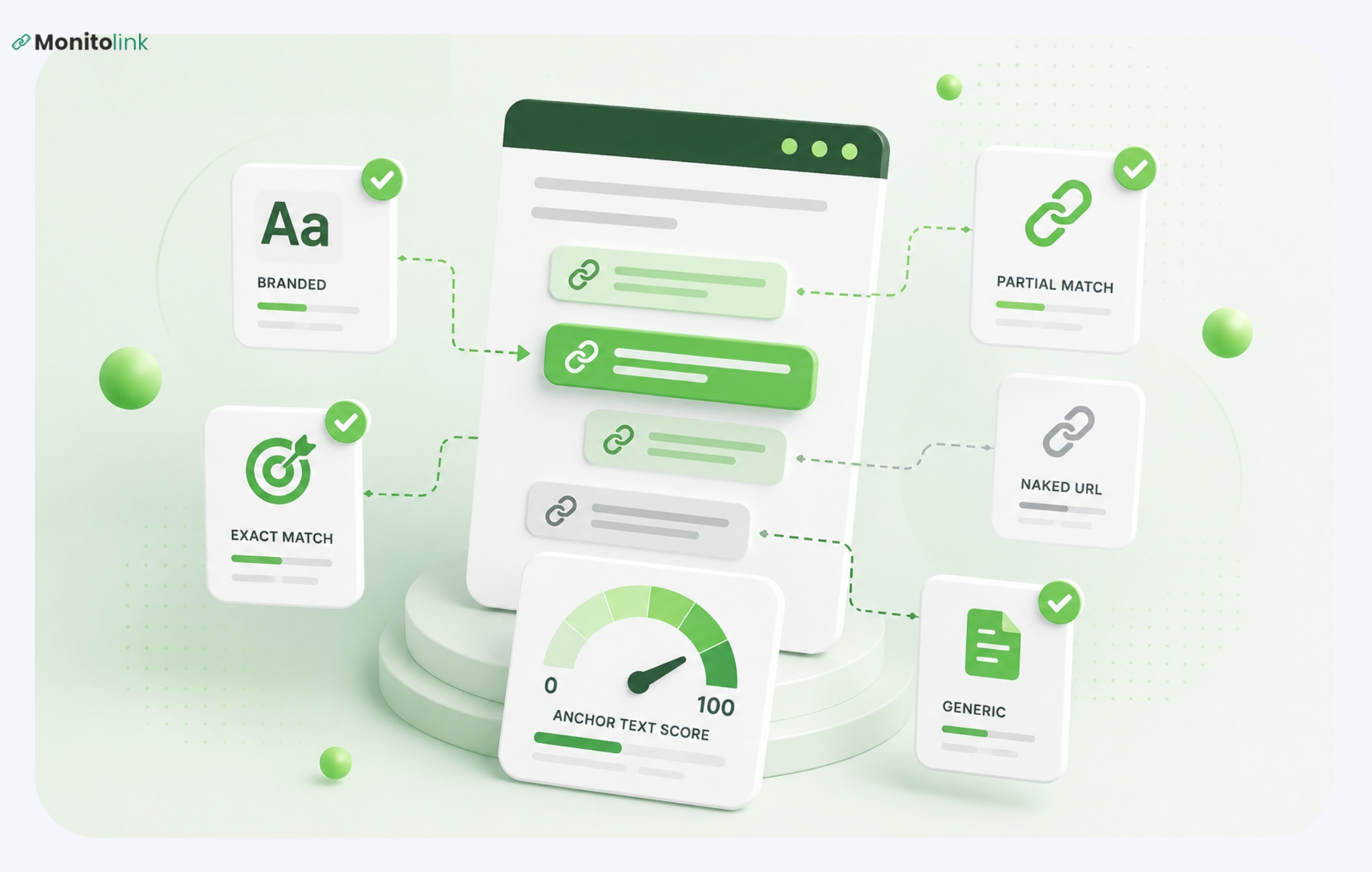
A healthy link profile uses a mix of these anchor text types. Relying on just one or two types is the single biggest tell that a link profile isn't natural.
Let me just say that an exact match isn’t inherently bad. It has a clear high correlation with over-optimization penalties, but only because it’s being used too often. You can and should use it (in moderation, of course).
What's the Right Anchor Text Ratio?
You'll see advice ranging from "under 1%" to "under 10%" for exact match anchors, with no real explanation of why. Here's a distribution that reflects what holds up across a normal link profile, based on patterns we see across the backlink profiles we monitor at Monitolink:
Two things worth calling out:
- This is a range, not a rule. A new site with a thin backlink profile should stay closer to 1-2% exact match. A well-established domain with hundreds of natural referring domains has more room, but "more room" still means single digits.
- The ratio only matters in aggregate. One exact-match anchor from a high-authority site isn't a problem. Fifty identical exact-match anchors pointing at the same URL, especially from similar-looking sites, is exactly the pattern Penguin was built to catch.
If you're managing links for multiple clients or a large site, the real challenge isn't knowing the target ratio - it's knowing what your actual ratio is right now, across every referring domain you've picked up over the years. That's a data problem, and it's usually where anchor text optimization efforts quietly fall apart: nobody's tracking the distribution as it drifts.
Internal vs. External Anchor Text: What Changes
The rules change a bit depending on whether you're linking within your own site or being linked to from someone else's.
Internal links - you have full control. Use descriptive, keyword-relevant anchor text. Since you own both ends of the link, there's no risk of "unnatural" acquisition. The only risk is repetition. If every internal link to your pricing page uses the exact phrase "SEO pricing," that's still a pattern Google can flag, even internally.
External links - you don't control what other sites use. When you're the one earning backlinks, you can't dictate anchor text (and you shouldn't try to, through link schemes or paid placements that specify exact-match anchors - that's a Google Webmaster Guidelines violation). What you can control is your own outreach and guest content, where branded and naked URL anchors are the safest defaults. Save exact and partial match requests for situations where the context genuinely calls for it.
In short, your internal linking strategy should lean keyword-descriptive, and your external link-earning strategy should lean branded. Mixing these up - over-optimizing internal links while chasing exact-match backlinks - is a common mistake that creates risk on both fronts at once.
How to Write Anchor Text That Works: 5 Best Practices
I will keep this checklist short and sweet:
- Keep anchor text under five words so it's easy to scan and doesn't dilute keyword relevance.
- Match the anchor to the destination - if it says "pricing," it should link to the pricing page.
- Vary your phrasing every time you link to the same URL; identical repeated anchors are the clearest unnatural-linking signal out there.
- Let the anchor read naturally in the sentence - if you're bending the sentence to fit a keyword, pick a different anchor.
- Make the link visually obvious, since underlining or color contrast is an accessibility issue as much as a UX one.
Anchor Text Spam and the Penguin Update
Anchor text spam happens when anchor text is used to manipulate rankings rather than help users. The most common patterns:
- Exact-match overuse is earning or building many links where the anchor is always the exact keyword you're targeting.
- Keyword stuffing means cramming multiple keywords into one anchor, like "best cheap SEO tool backlink monitoring software."
- Irrelevant anchors are just as bad - anchor text with no real connection to the page it links to, which is often a red flag for paid links or hacked, spammy sites.
Exact-match anchors used to be one of the easiest ways to boost rankings - then Google's 2012 Penguin update flipped that, and the same tactic started getting sites penalized instead. Now, Google weighs anchor text against the surrounding content and the overall quality of the link.
Most of the time, if something looks off, Google just quietly discounts those links. A manual action is different - that's the serious version, and you'll see it flagged in Search Console. That's really the only point where disavowing links makes sense. Without clear evidence of a penalty, removing or disavowing links tends to cause more harm than it fixes.
How to Add Anchor Text (By Platform)
HTML
<a href="https://example.com">your anchor text</a>
WordPress
Highlight your text > click the link icon in the editor > paste the URL > press enter
Shopify
Select the text in the rich text editor > click the insert link button > add the URL > apply
Wix
Highlight the text > click the link icon > choose "web address" > enter the URL > save
How to Audit Your Anchor Text Profile
You can't optimize a ratio you can't see. Here's the process:
- Pull every referring domain and its anchor text. You need the full list. Over-optimization is invisible until you look at the whole picture.
- Bucket each anchor into the categories above (branded, exact match, partial match, etc.) and calculate your percentages.
- Flag anchors that repeat identically across multiple domains. This is the pattern that matters more than any single ratio number.
- Re-check this regularly. Anchor profiles drift as you earn new links and lose old ones - a profile that was clean six months ago can quietly tip into an unhealthy exact-match ratio without anyone noticing, especially as links get lost, redirected, or changed by the linking site.
That last point is the one most link-building strategies miss. Anchor text optimization isn't a one-time audit - it's an ongoing monitoring problem, because you don't control what happens to your links after they're published.
This is exactly the gap that tools in this space are built to close, and it's worth knowing what's available before you pick one. I’ll share a few options below.
Tools for Anchor Text and Backlink Monitoring
Monitolink
Monitolink is a backlink monitoring and recovery tool that tracks every link you have 24/7, and alerts you the moment one gets lost, changed, or deindexed. You can also see exactly what anchor text was used in each backlink you have.
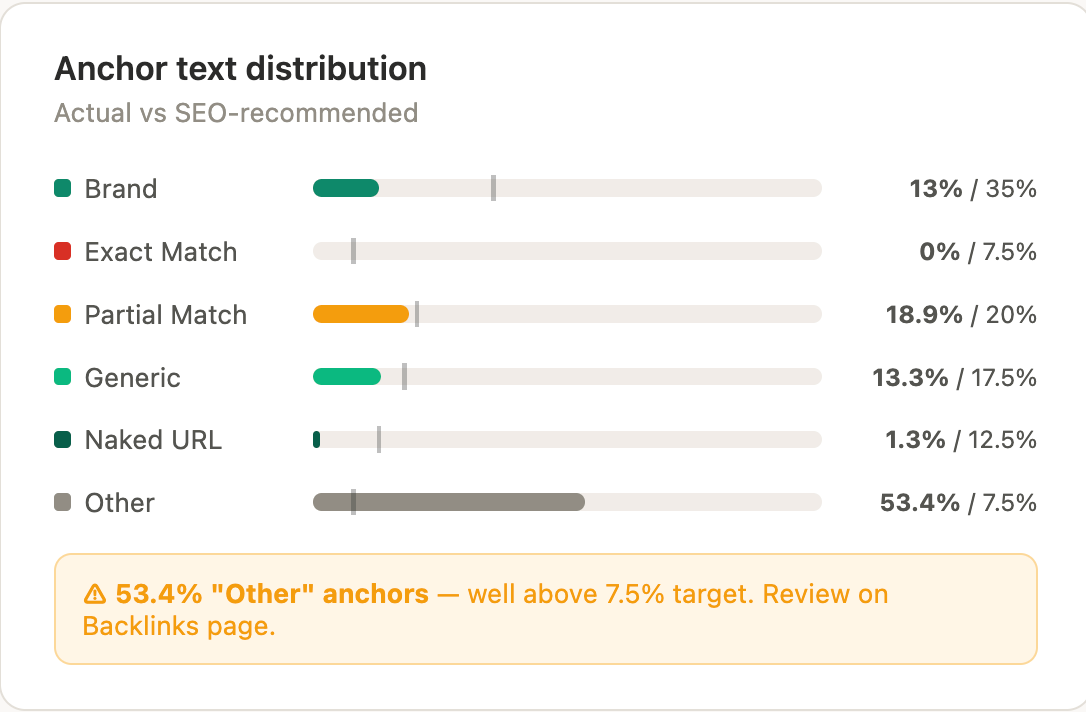
Once this picture is clear for you, and let’s say you don’t like some of the anchor texts, you can retrieve the contact of the website in one click, do an outreach directly from the platform, and ask to optimize the anchor text according to your needs.
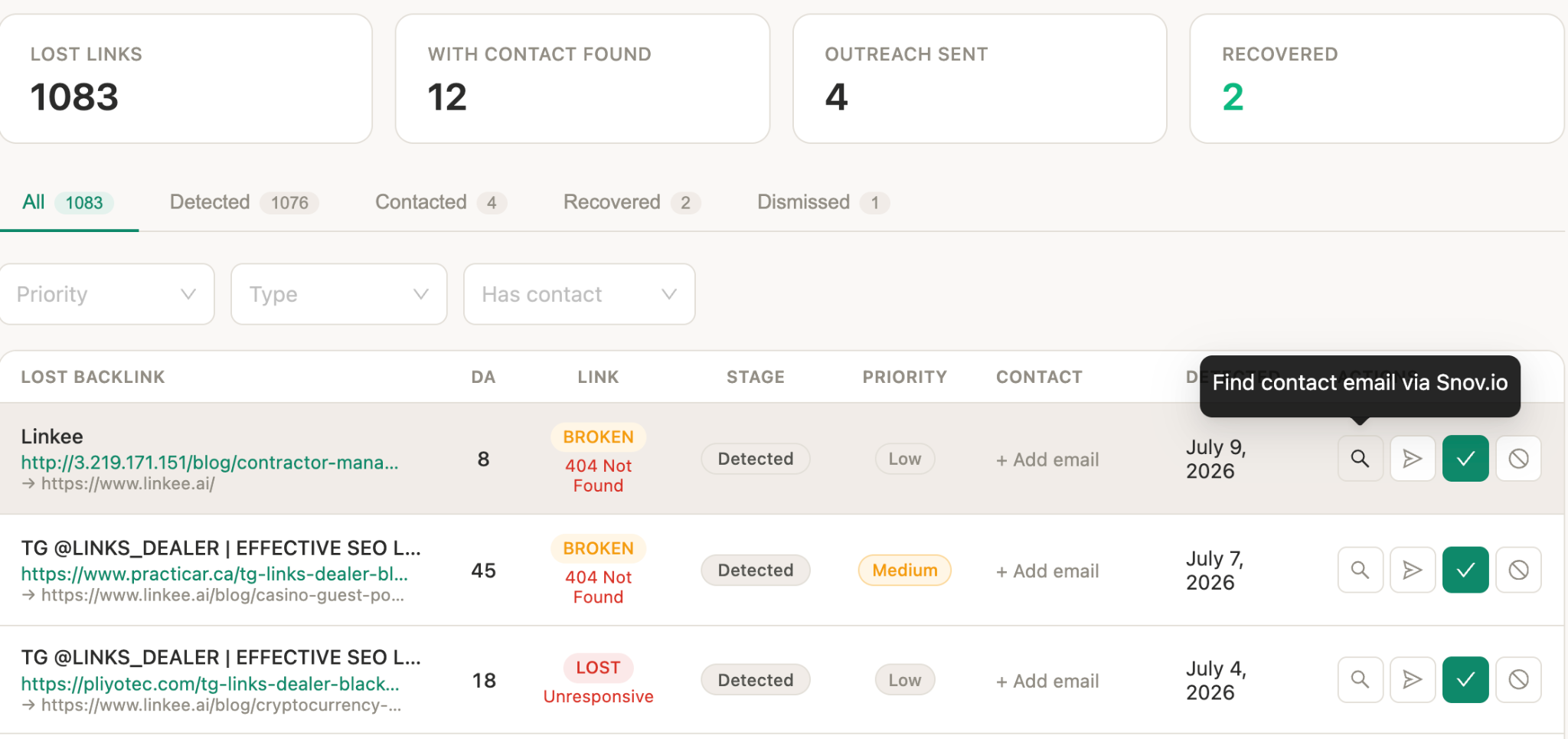
You get some extra benefits as well, like:
- AI-powered anchor optimization and toxicity detection. Monitolink's AI layer analyzes your anchor text distribution and flags toxicity risk automatically - which is precisely the ratio-drift problem covered above, without needing to manually bucket every anchor yourself.
- Competitor backlink intelligence. Surfaces domains linking to competitors but not to you, so your outreach list writes itself.
- Agency-ready reporting. White-label PDF reports show active, lost, and recovered links, with CSV export for deeper analysis - cutting reporting time from hours to minutes.
- Bulk import. Pull in existing backlink data from Ahrefs, Semrush, or Google Search Console via CSV, so switching tools doesn't mean starting from zero.
Monitolink currently monitors 2M+ backlinks for 500+ SEO teams, with paid plans starting around $29/month - plus a 14-day free trial, no credit card required.
For anchor text optimization specifically, this is the piece most workflows are missing: you can build a perfectly balanced anchor profile today and have it drift within a year as links get lost or altered. Monitoring closes that loop.
Ahrefs
A widely used backlink index with an anchor text report that shows the distribution of anchors pointing to any domain or URL. Strong for one-off audits and competitive research; refresh cycles are typically weekly rather than real-time.
Semrush
Similar positioning to Ahrefs - a broad backlink and anchor text analysis suite, plus a Backlink Audit tool that flags toxic anchors by type (exact match and compound anchors are typically the highest-risk categories it surfaces).
Anchor Text for Images (Alt Text)
Your alt text is your anchor text, when the link goes out from an image.
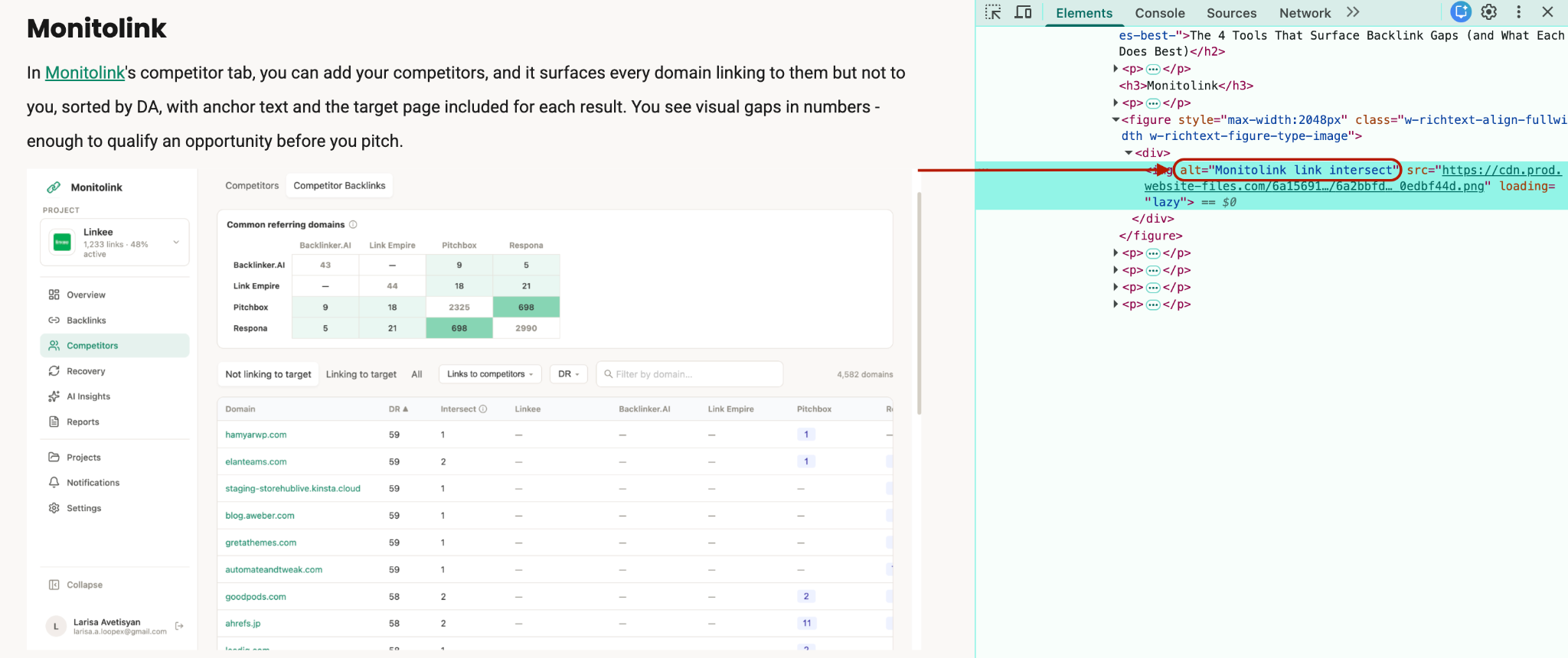
So, the same rules and best practices apply: keep it short, make it relevant, and don't stuff it with extra keywords.
Don’t do something like "SEO tool backlink monitoring software best link tracker". This tag is nothing more than keyword stuffing masquerading as an accessibility feature.
The Bottom Line: Anchor Text Optimization Best Practices
If you’ll just read one section, read this. To optimize your anchor text, follow these simple steps:
- Make sure your anchor text is descriptive of the destination page.
- Most of the links pointing to your website should use your brand name (50-60%).
- Vary your phrasing every time you link to the same URL - repetition is the clearest spam signal.
- Lean keyword-descriptive internally, branded externally - never dictate exact-match anchors through outreach or paid links.
- Keep anchors under five words and let them read naturally in the sentence.
- Treat alt text on linked images with the same rules as anchor text - concise and accurate, never stuffed.
- Audit your full anchor profile regularly, since it drifts as links get lost, changed, or redirected over time.
And if you need a tool to support your work, use Monitolink’s AI backlink profile analysis feature to get your current anchor profile in front of you in minutes.
Frequently Asked Questions
Is "Click Here" A Bad Anchor Text For SEO?
Not inherently - generic anchors are fine in small doses and can actually make a link profile look more natural. The problem is relying on them so heavily that you lose the context that the descriptive anchor text would have provided.
Do Naked URLs Pass SEO Value?
They can be considered links, and even Google says that they do pass on value, but they offer less information for the search engine on what the target page is about than descriptive anchor texts do.
How Many Links On A Page Would Be Too Many?
It is hard to say any number, but if you start putting five or six links to different pages within a few sentences, then you’re losing their value and attention of your readers.
Does Anchor Text Still Matter in 2026?
Yes. Google's ranking systems have gotten better at reading context around a link, but anchor text is still part of that context - it just can't carry a ranking on its own the way it could in early SEO.