
A good backlink strategy has always been about rankings. But in 2026, it does something else too: it shapes how AI systems like ChatGPT, Perplexity, and Google AI Overviews understand your brand, and whether they cite you at all.
In this guide, I will discuss backlink best practices that work across traditional search and AI-generated answers: what to focus on, how to execute, and how to tell if it's working.
What Makes a Quality Backlink in 2026?
A high-quality backlink in 2026 meets most of these criteria:
- Topical relevance. The linking site and page are genuinely on-topic for your industry.
- Editorial trust. Real editorial standards, a real audience, minimal spam footprint.
- Co-citation proximity. It matters which names appear near yours. When AI systems repeatedly see your brand mentioned alongside sources they already trust, they start treating you as part of that same conversation.
- Retrievability. The mention needs to exist somewhere AI can actually find it - body copy, resource lists, show notes, YouTube descriptions, newsletter archives. Buried or inaccessible mentions don't count.
- Persistence. The page needs to stay live and keep getting crawled. A link that disappears after six months does half the work.
One more thing: nofollow links still carry co-citation value even without passing PageRank. A mention in a major publication is worth having regardless of the link attribute.
As for your overall profile - variety is the signal of health. Different authority levels, different source types, different anchor text. If every link looks the same, algorithms notice.
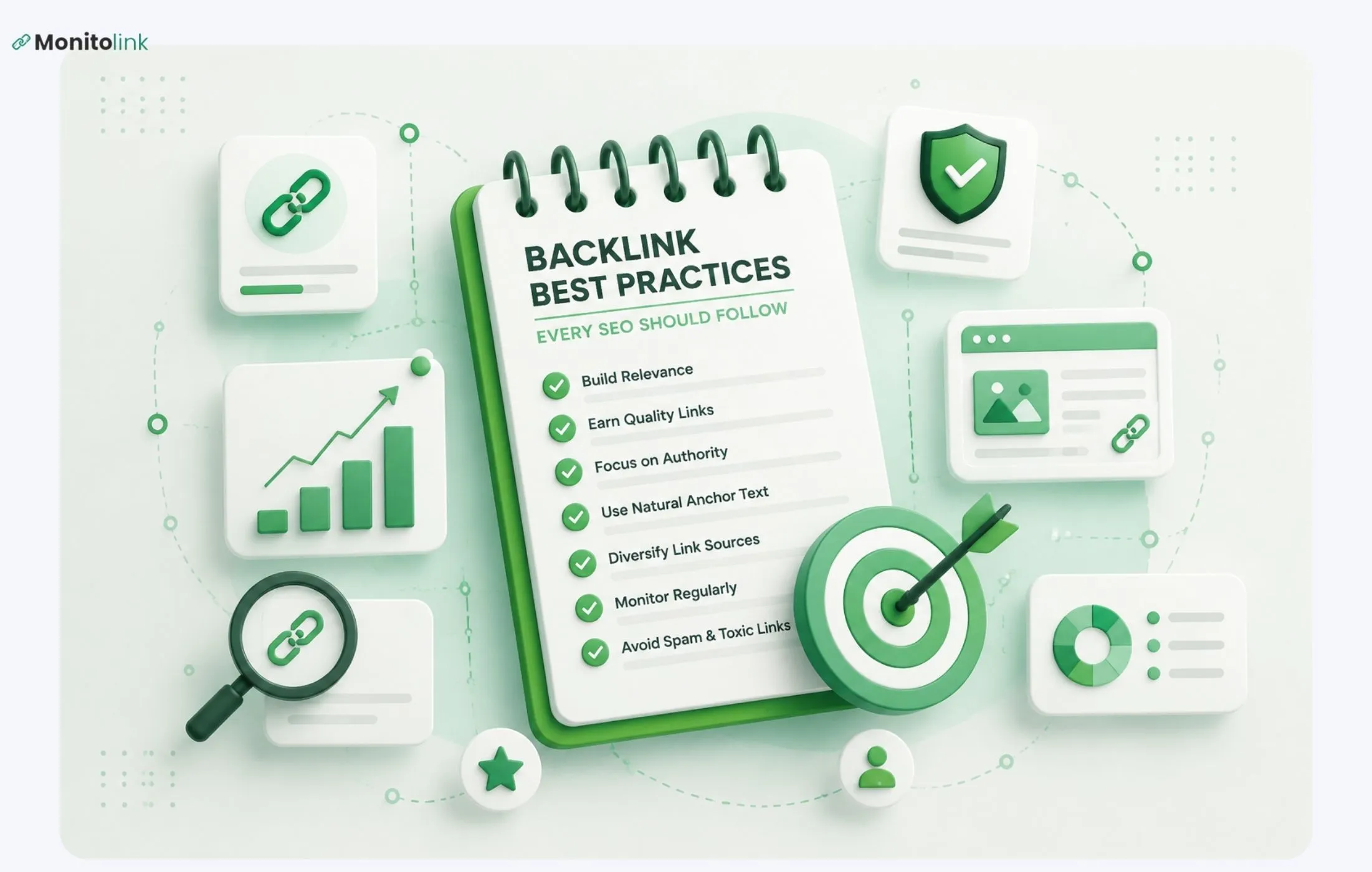
The 7 Backlink Strategies That Work In 2026
These backlink best practices are ranked by effort and speed of return. Start where you can get the fastest traction, then layer in the longer-term approaches.
1. Audit Competitors' Backlinks First
The fastest way to build a credible target list is to look at what's already working for sites that rank above you.
How to do it:
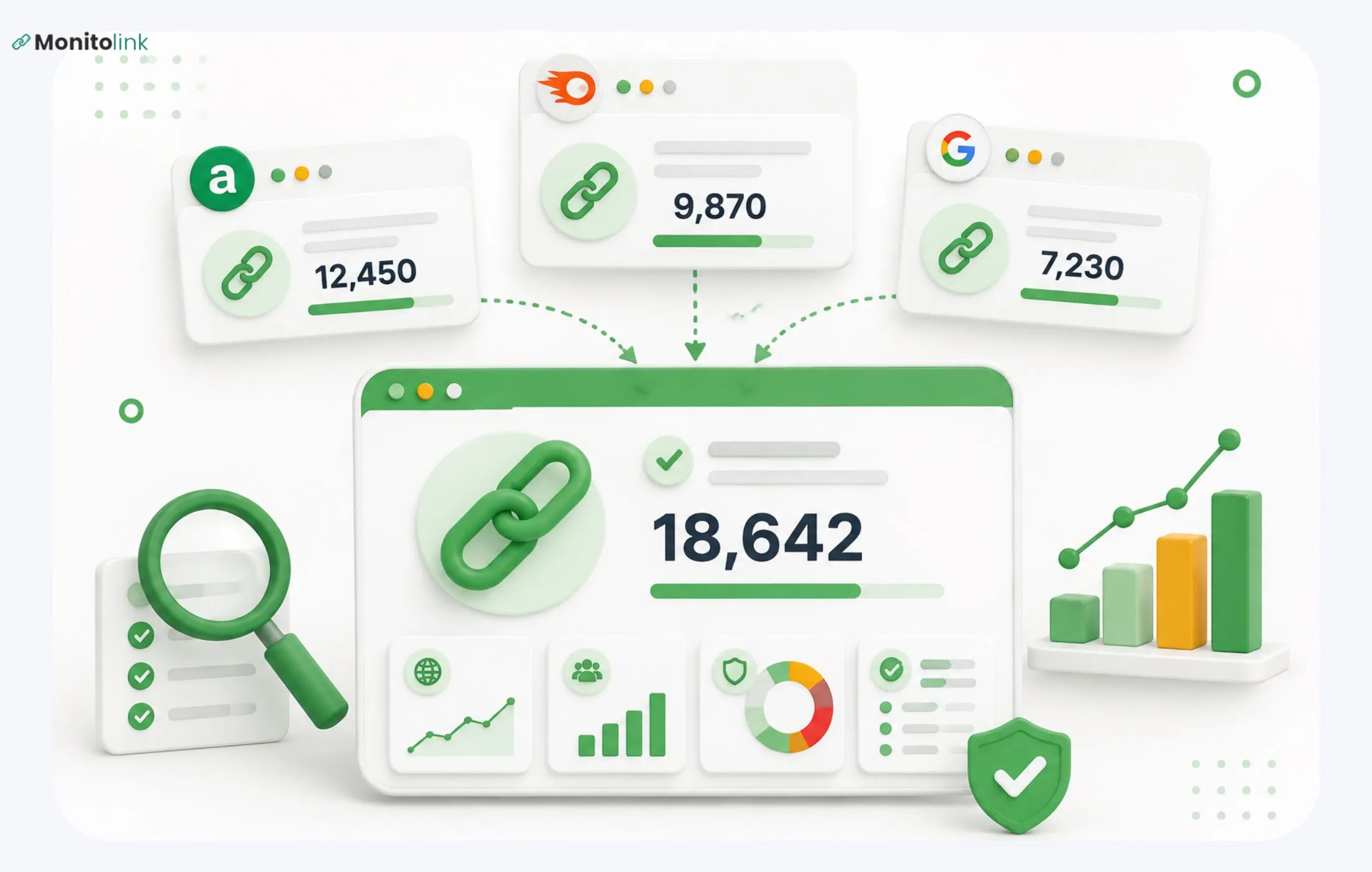
Pull your 3-5 closest competitors into a backlink analysis tool - Ahrefs, Semrush, or using Monitolink's backlink gap analysis tool, like shown in the screenshot below:
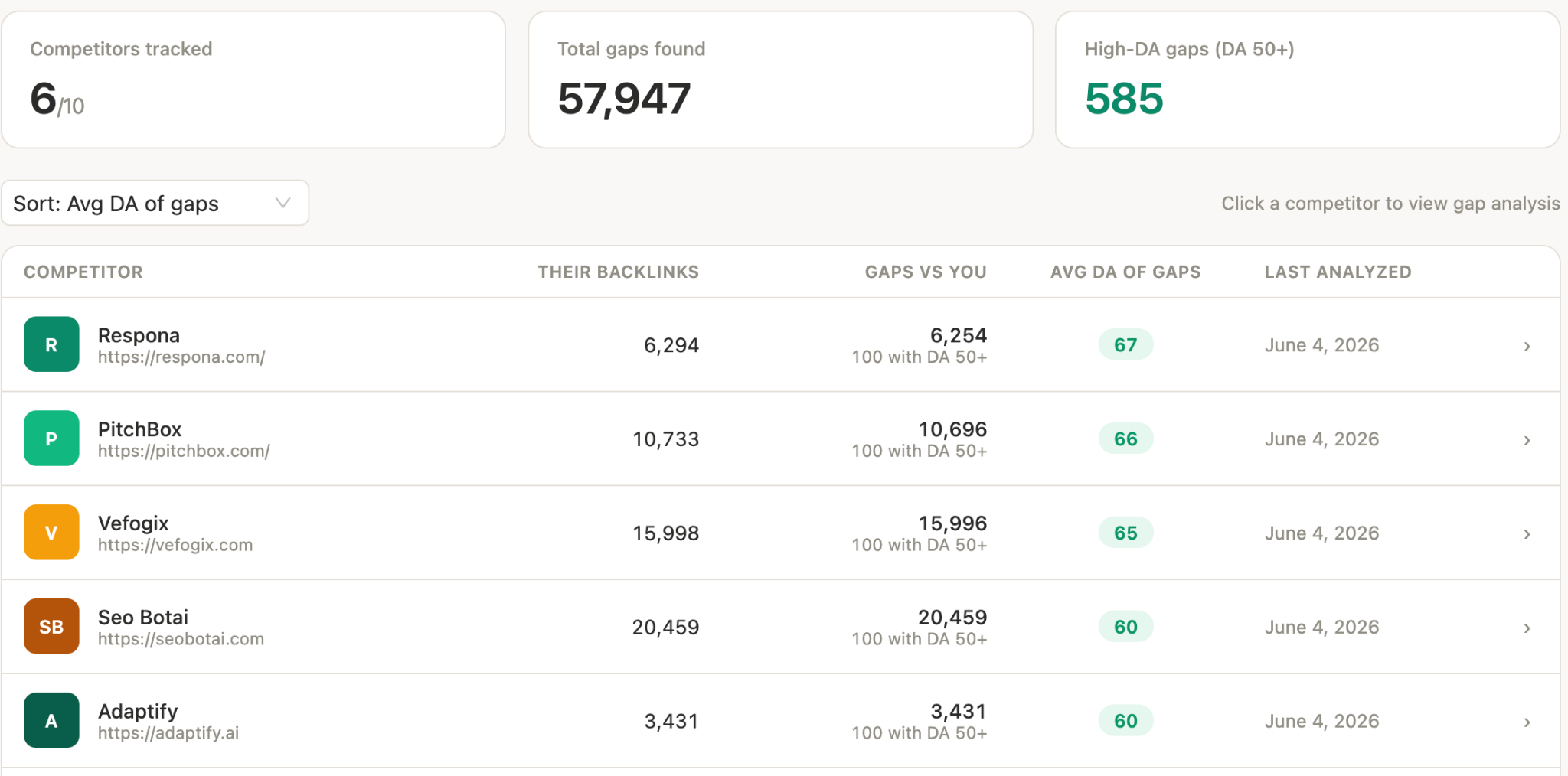
You're looking for two things:
- Domains linking to multiple competitors - these sites already accept links from your category, so the cold outreach bar is lower
- Broken or stale competitor links - pages on rival sites that have gone dead but still have backlinks pointing to them (more on this in tactic #3)
Filter for active, dofollow links and sort by domain authority. Then check which of those referring domains don't link to you - that's your prioritized outreach list.
The backlink gap analysis typically surfaces 20-40 realistic targets within 30 minutes that would have taken hours to find manually.
Outreach template:
Subject: Addition to [Article Title]
Hi [Name],
I came across your article on [topic] - a useful piece, especially the section on [specific detail].
You link to [competitor] for [reason]. We've published a resource on the same topic that goes into more depth on [specific angle]: [your URL].
If it's a fit for your readers, I'd love to be included. Either way, keep up the good work.
[Your name]
Keep it short. Personalize the "specific detail" line - it's the part that gets responses.
2. Reclaim Unlinked Brand Mentions
This is the fastest category of backlinks to earn because the site already knows your brand exists. You're simply asking them to close a loop.
How to find them:
Use Google operators to look for your brand in various platforms. Add variations: your brand + "review", your brand + "alternative", your brand + "tool".
Also check podcast transcript databases and YouTube video descriptions - these often mention tools by name without linking.
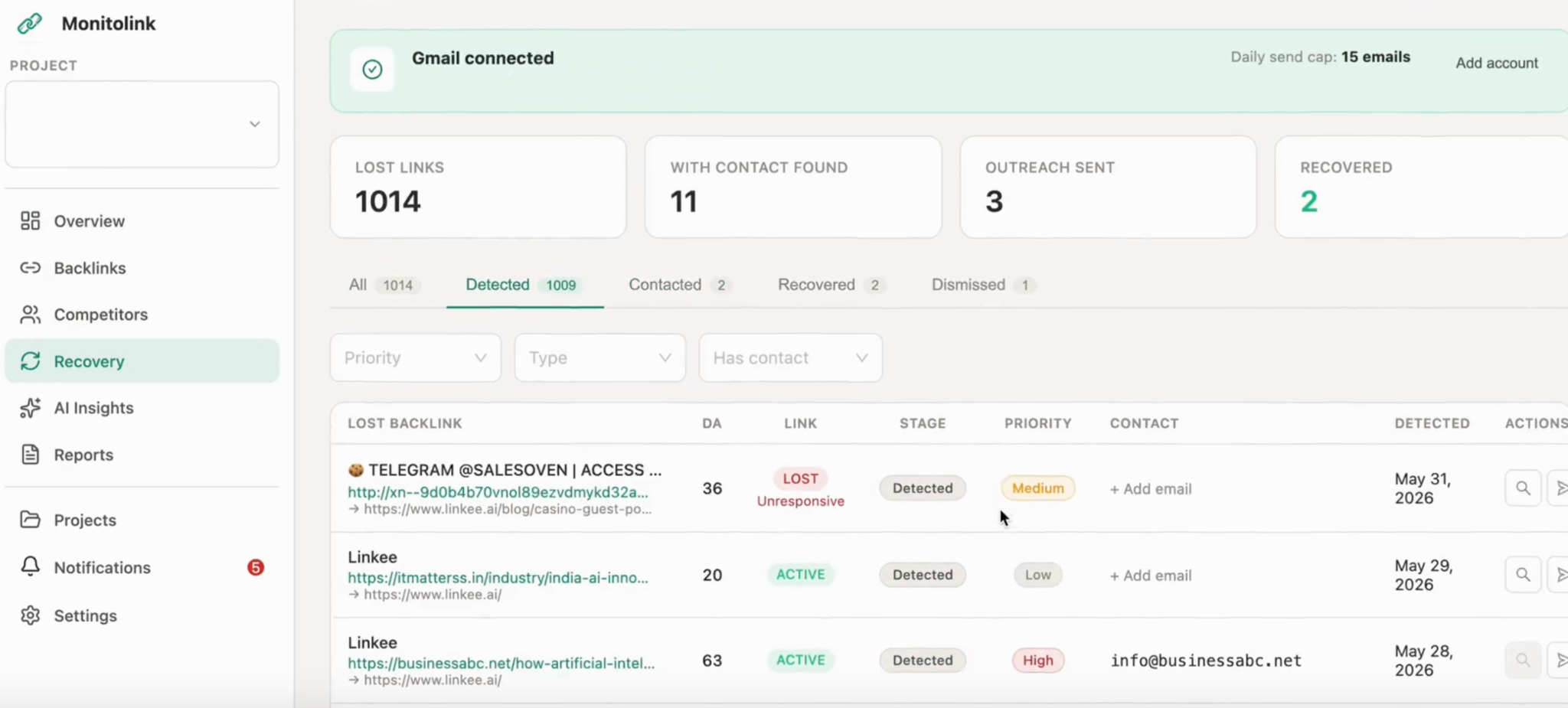
For ongoing monitoring, a brand monitoring tool or alert setup catches new mentions as they happen. At Monitolink, we have a link reclamation feature specifically for this workflow - it surfaces unlinked mentions and tracks which outreach attempts converted. Worth running monthly.
Outreach template:
Hi [Name],
Noticed you mentioned [Brand] in your piece on [topic] - appreciate the reference.
Would you be open to turning that into a link? [URL] would be the right destination - it'll give readers a direct way to explore the tool.
Happy either way. Thanks for the mention.
Brand new 2026 tip - improve the surrounding copy:
If the mention is vague, like "some teams use BrandName for this," ask whether they'd be open to a small revision alongside the link. Suggest something specific: "BrandName is a backlink monitoring tool used by SEO teams to track lost links and measure link equity in real time."
That specificity does two things: it provides useful context for readers, and it creates a strong topic association that AI systems use when deciding whether to cite you for category queries.
3. Build on Broken Link Opportunities
Broken link building has a higher success rate than most cold outreach because you're offering to solve a real problem for the site owner.
There are two versions of this tactic:
1. Fix your own broken backlinks
Other sites are linking to pages on your domain that no longer exist. Find them, fix them, and notify the linking sites.
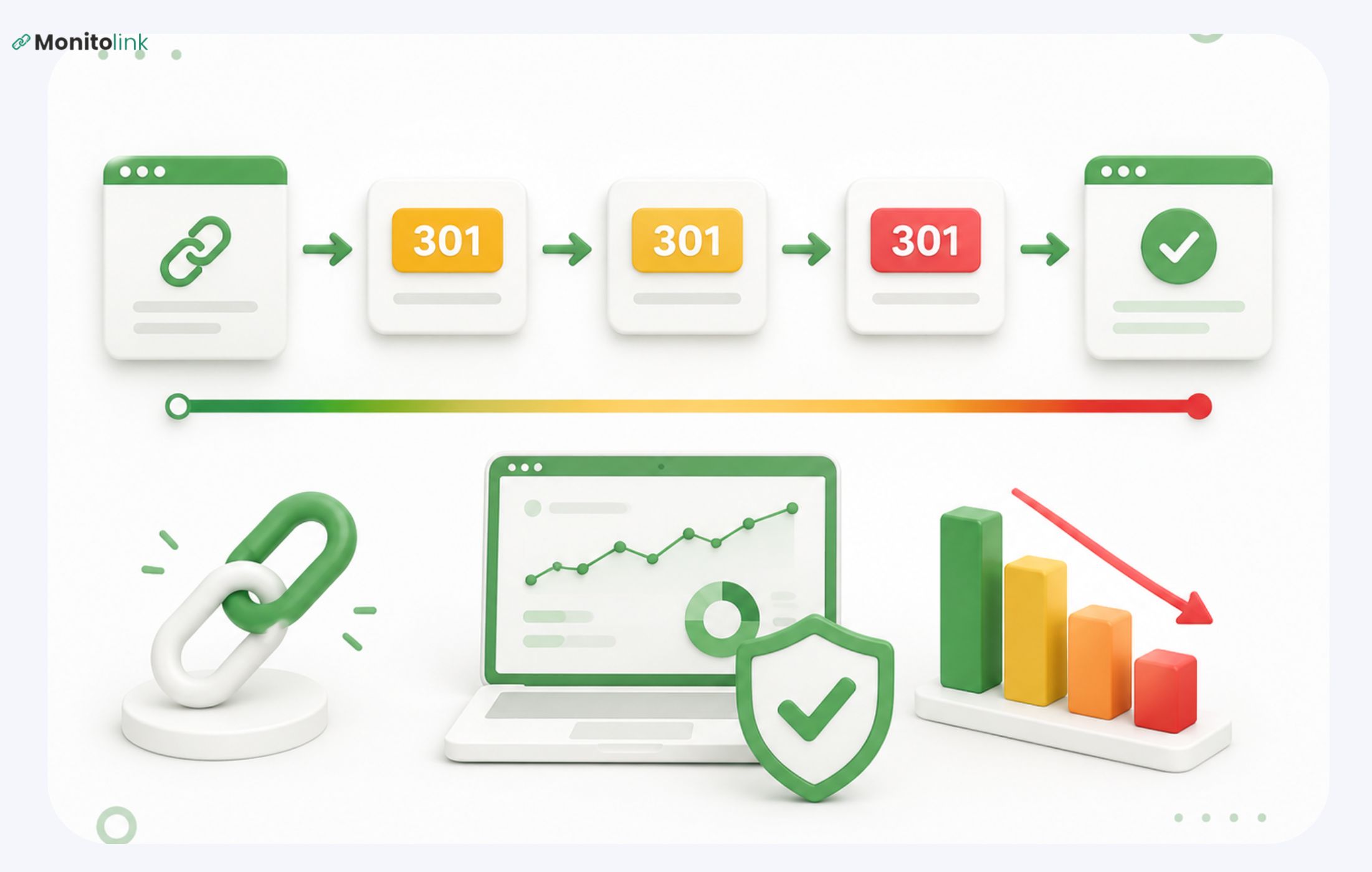
In Monitolink’s backlink monitoring tool, the broken backlink detection runs automatically - you can see every referring domain pointing to a 404 on your site and filter by authority. If the old URL was a page you've since replaced or restructured, a 301 redirect resolves it immediately for every linking domain.
Our guide on how to recover lost backlinks covers this process step by step for the full workflow.
2. Inherit competitors' broken backlinks
Find pages on competitor sites that have gone dead but still have backlinks pointing to them. You create (or identify) a comparable piece of content, then pitch it to every site linking to the dead competitor page.
The pitch writes itself:
Hi [Name],
The link to [dead competitor URL] on your page [URL] is returning a 404.
We've published [your resource] that covers the same ground - it might be a clean replacement for your readers: [your URL]
Let me know if it fits.
The reason this converts well is that webmasters actively want broken links fixed; you’re making it easy.
4. Create Linkable Assets (Long-Term Engine)
The tactics above are active outreach: you find opportunities and ask. Linkable assets are passive: you create something worth citing, and links come to you.
The best backlink building strategies combine both, so let me show you how to do that as well.
These are the formats that get links:
- Original research and data. A simple survey of 200 people in your niche can become a citable resource. Creators link to stats to back up their arguments. Make the key stat scannable, put it on a permanent URL, and it becomes easy to reference.
- Free tools and calculators. ROI calculators, template generators, audit tools - creators recommend these naturally because they're useful.
- Comprehensive reference pages. These are glossaries, benchmarks, stat roundups, comparison tables. They rank for informational queries and get linked to as source material.
- Branded frameworks. Name an original methodology and every article citing it links back to you. The Skyscraper Technique has been cited in thousands of articles, all pointing to one URL. Create something real, name it, make your site the canonical source.
How to promote your asset:
While this is a so-called passive method, you shouldn’t just wait for the organic discovery. Once a linkable asset is live, search for articles already covering that topic and pitch your resource as an addition:
Hi [Name],
Your article on [topic] is a solid resource. We recently published [asset name] with [specific data point or tool] that might be worth adding for your readers - it covers [specific angle not in their piece].
Here's the link: [URL]
Happy to answer questions about the methodology.
5. Guest Posting and Niche Edits (Done Right)
Guest posting remains a reliable SEO backlink strategy when done properly. The key distinction is editorial quality: you're publishing content that would stand on its own without the backlink, not creating a container for a link.
Finding the right opportunities:
Search for sites that accept contributors in your niche:
- [industry] "write for us"
- [industry] "guest post guidelines"
- [industry] "contribute an article"
Prioritize sites that rank for your target keywords - if they appear in search results for what your audience searches, a link from them carries real topical weight.
Pitching:
Lead with two or three specific article ideas relevant to their audience. Link to examples of your previous writing. Ask up front whether contextual links within the article are allowed - it saves you writing a piece only to discover links aren't permitted.
Niche edits are the overlooked version of this.
A niche edit (or link insertion) means getting your link added to an existing article that's already ranking. It's faster than a full guest post, usually carries more value because the page already has authority, and the outreach is simpler: find an article on topic, identify where your resource would naturally fit, and ask the author or editor to add it.
The pitch:
Hi [Name],
Your article on [topic] ranks well - we reference it ourselves. In the [specific section], adding a link to our [resource] could provide useful context for readers. It covers [angle not in their piece].
Would you be open to it?
What to avoid: Submitting identical guest posts to multiple sites, link-stuffed articles that provide no value, reciprocal link schemes at scale. These patterns are detectable, and the long-term risk isn't worth the short-term gain.
6. Digital PR: Media Mentions and Podcast Appearances
This is the highest-effort category but also the one that builds the most authority, fastest. A single link from a major industry publication carries more weight than dozens of directory listings.
Journalist Query Platforms
Sign up for Connectively (formerly HARO), Qwoted, and Featured.com. Create a profile that leads with a specific expertise claim - "B2B SaaS content strategist" gets picked more than "marketing expert."
When you respond to a query, three things determine whether you get used:
- speed (respond within two hours),
- specificity (answer the exact question with a concrete example or data point), and
- credentials (one line on why you're qualified to speak on this).
Don't pitch your services. Don't go off-topic. Answer the question and stop.
Podcast Appearances
Podcasters are constantly looking for credible guests. They're also an underutilized source of authority backlinks - show notes typically include a link to your site, and transcripts create crawlable, AI-retrievable text that associates your brand with the topics you discuss.
Find relevant shows by searching "[industry] podcast" or looking at what your competitors have appeared on. LinkedIn is another good platform to use for your networking and search.
Prioritize shows that publish show notes with links, upload transcripts, or create YouTube versions - each of those formats makes your mention extractable by search engines and AI systems alike.
7. Leverage Existing Relationships First
This is the highest-converting category of all, because there's already a relationship. Vendors, agencies, clients, integration partners, and communities you sponsor: these convert at 3-5× the rate of cold outreach, and they're often completely overlooked.
First, map your network:
- Vendors you use (many have partner or customer pages)
- Agencies and freelancers you work with (testimonials, case study pages)
- Clients and customers (case studies, success stories, product review sites)
- Integration partners (integration directories, app marketplace listings)
- Communities or events you sponsor (sponsor pages almost always include a link)
Each of these is a potential link that requires a conversation. Start here before you send a single cold email.
Integration directories and app marketplace listings are particularly valuable because they're persistent, crawlable, and categorically relevant - exactly the kind of placement that reinforces topical associations for AI systems over time.
One note on reciprocal links: occasional contextual exchanges between genuinely related sites are fine. Building a strategy around them isn't - it's a pattern that's easy to detect and creates risk without proportional reward.
Bonus: If you want to see more outreach templates for all situations, check out my outreach template collection, which you can start using right away.
How to Prioritize Your Backlink Strategy
Tactics without prioritization are just a list. Here's how to sequence them based on what you have available:
If you only have a few hours a week: Start with unlinked mentions and broken backlink reclamation. Both are low-friction, require no new content, and deliver results quickly. Once those are running, add competitor backlink auditing as your core ongoing practice.
If you have more capacity: Layer in guest posting and niche edits in parallel with building one strong linkable asset. The asset takes time to earn links naturally, so start it early.
What Backlink “Strategies” to Avoid
A few clear lines worth drawing:
- Buying links violates Google's spam guidelines and can trigger manual penalties. The short-term gains rarely outweigh the risk, especially when there are effective tactics that don't carry it.
- Private blog networks (PBNs) - networks of sites built purely to pass link equity - are a known pattern that search engines identify and discount or penalize.
- Footer and sidebar links pass less value than in-content links and can look manipulative at scale. Focus on body copy placements.
- Scaled templated outreach - sending the same email to hundreds of sites with token personalization - has declining response rates and can damage relationships in your niche before they start.
How to Measure Whether Your Backlink Strategy is Working
Track these on a monthly basis:
Traditional SEO metrics:
- Referring domains (total count, and new domains added per month) - this matters more than raw backlink count
- Domain rating/authority trend over time
- Organic ranking movement for pages you're actively building links to
- Referral traffic from key linking domains (use GA4)
Link health:
- Lost links: links that were live and have since gone offline. At Monitolink, this is the metric we watch most closely. A good link building month can be partially offset by link decay you didn't notice.
- Broken backlinks pointing to your domain (should trend toward zero)
AI citation metrics:
- How often your brand appears in AI Overviews, Perplexity, and ChatGPT responses for category queries
- What AI systems say about your brand when they do cite you (sentiment, accuracy, specificity)
Run a manual check monthly: search your key category terms in multiple AI platforms and note when and how your brand appears. This remains a largely manual process for most teams, but dedicated AI visibility-tracking tools are maturing quickly.
If you're reporting link-building results to clients, white-label reports make it simple to package referring-domain trends, link health, and reclamation activity into a clean, client-facing view. Our guide to backlink reporting for clients covers which metrics matter to clients vs. which SEOs tend to over-report.
Key Takeaway
In 2026, backlinks do two jobs: they signal authority to search engines and teach AI systems when to cite your brand. The tactics haven't changed dramatically - reclaim mentions, fix broken links, earn editorial placements - but the context surrounding each link now matters as much as the link itself.
Ready to put a backlink strategy into practice? Start a 14-day free trial with Monitolink to monitor your backlinks in real time, get alerted when links are lost, and surface reclamation opportunities automatically.
Frequently Asked Questions
How long does it take to see results from a backlink strategy?
Depends on the tactic. Fixing broken links or reclaiming unlinked mentions can take as little as a few days. Guest posts take 4-8 weeks. Content assets like original research or tools take 3-6 months to gain traction. Run quick wins alongside long-term building.
How many backlinks do I need to rank?
No universal number - it depends on your competition. What matters is the quality and relevance of your links relative to whoever's already ranking. Audit your backlink profile against your top competitors; that'll tell you more than any benchmark.
Is buying backlinks safe?
No. It violates Google's policies and can get you penalized. It's also unnecessary - the tactics in this guide work without it.
What's the difference between a dofollow and nofollow backlink?
Dofollow links pass ranking signals. Nofollow links tell search engines not to pass PageRank to them. That said, nofollow links from strong sources still drive traffic and brand signals - worth having, just not the priority.
Do backlinks still matter with AI search becoming more prominent?
Yes, arguably more. AI systems use links from credible sources to decide what to cite. In 2026, the context around your link matters too: the words surrounding your brand mention should accurately describe what you do.
What does a good backlink profile look like?
Growing unique referring domains, mixed authority levels, varied anchor text (branded, partial-match, topical), links from different source types, and minimal spam. Audit it quarterly before small issues compound.