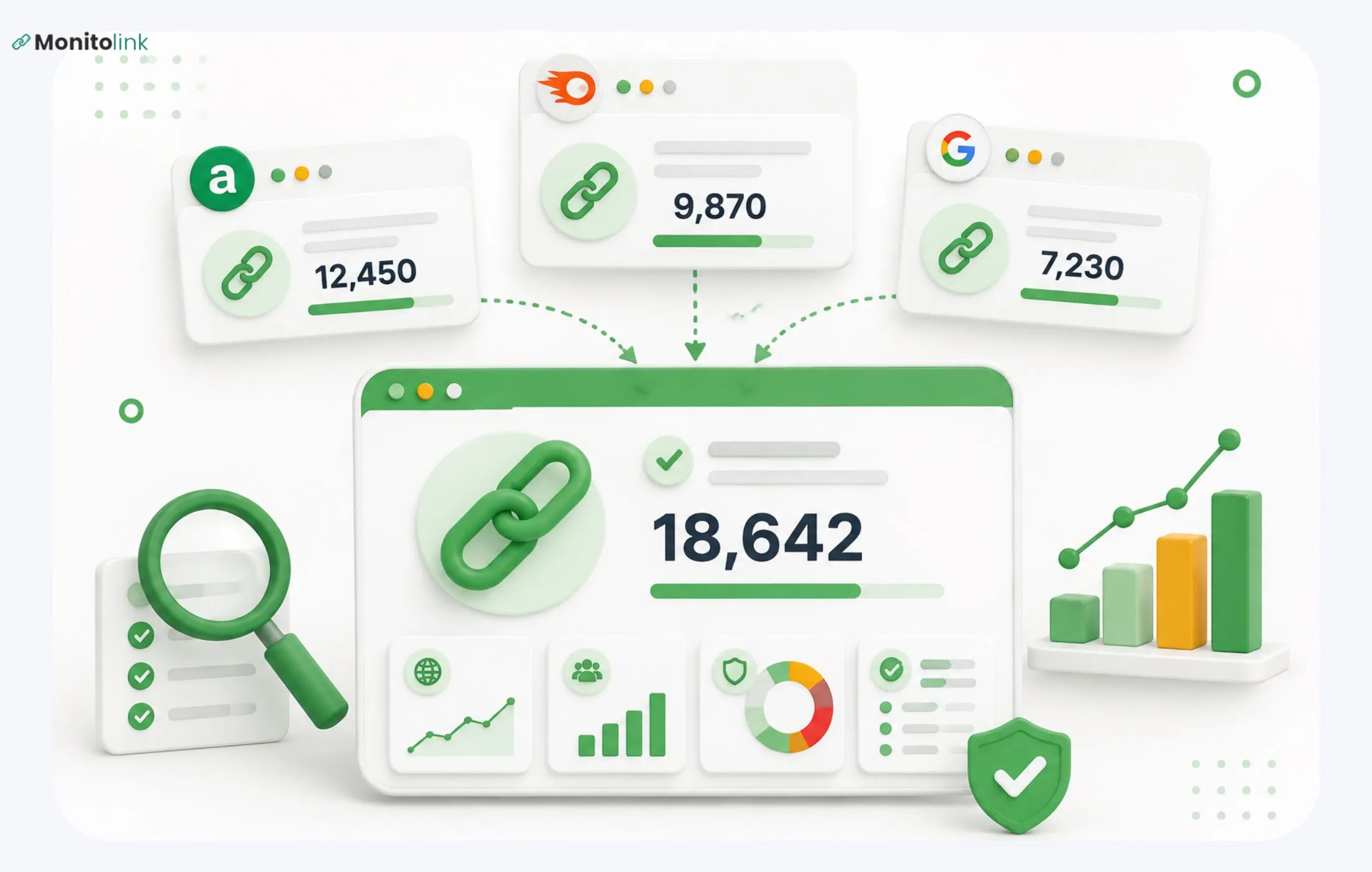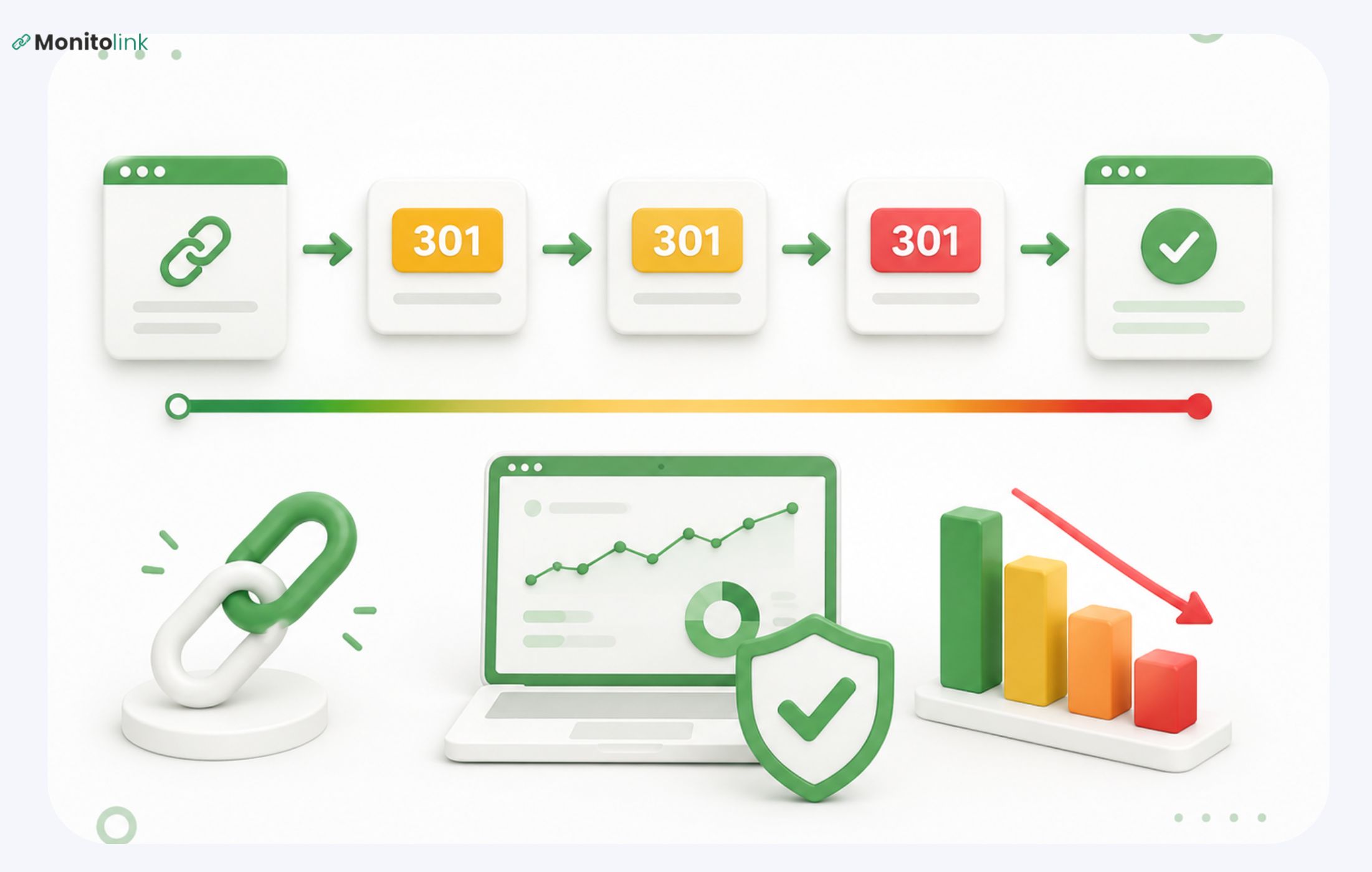

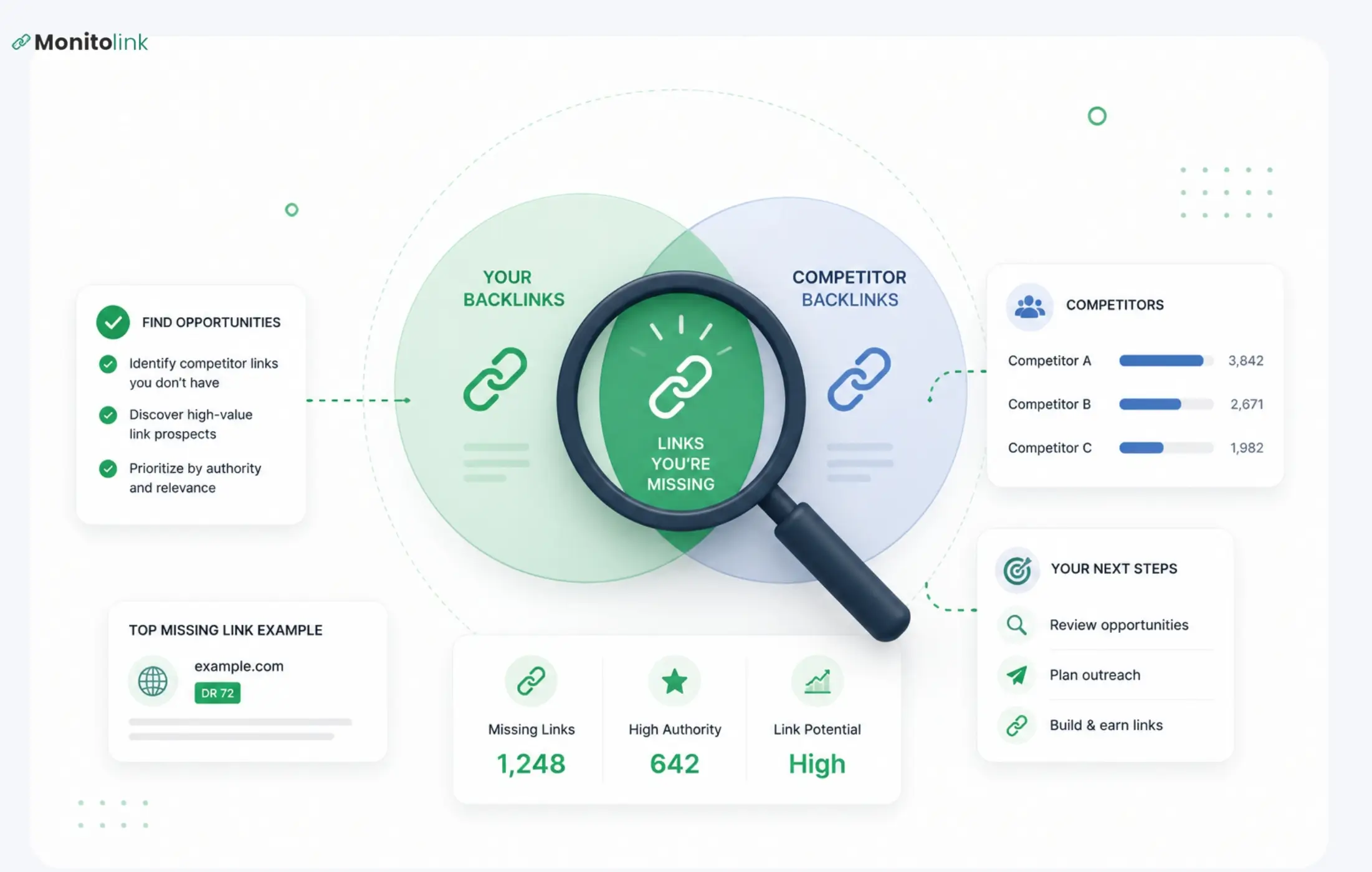
A backlink gap analysis shows you which sites link to your competitors but not to you, so you know exactly where to focus your outreach. You need these links to outrank them and get to page one as soon as possible.
In this guide, I’ll cover how to find the backlink gap, interpret it, prioritize it intelligently, and close it.
The 4 Tools That Surface Backlink Gaps (and What Each Does Best)
Most SEOs have a favorite tool, but they're not interchangeable. Each surfaces different data and drives different actions. Here's what actually matters about each one.
Monitolink
In Monitolink's competitor tab, you can add your competitors, and it surfaces every domain linking to them but not to you, sorted by DA, with anchor text and the target page included for each result. You see visual gaps in numbers - enough to qualify an opportunity before you pitch.
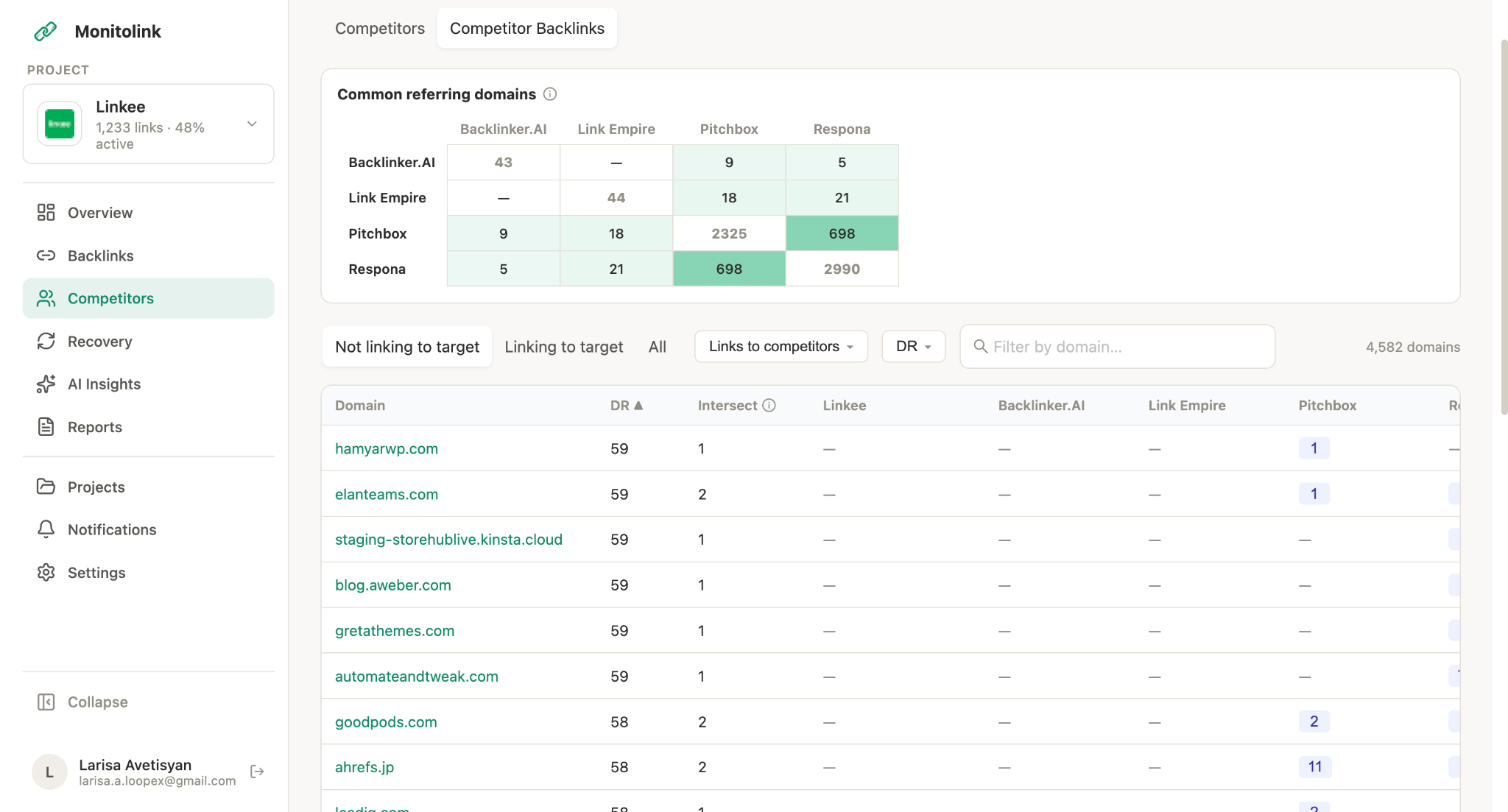
After you identify the gaps, you can reach out and have them filled from the same dashboard (Recovery tab). I will cover this later.
Another unique feature is that Monitolink monitors your full backlink profile continuously; you always know exactly where the gap stands - which domains you've closed, which ones you've lost ground on, and when new opportunities open up. The gap list isn't a snapshot you pull monthly. It updates itself.
How to use it: Add three to five organic competitors in the Competitors tab. Sort by DA descending. When you're ready to act, you don't need to export anywhere - connect your email, set a recovery template, and contact gap domains directly from the dashboard. You're not just mapping the competitor gap. You're filling it from the same screen.
What you get: The only tool on this list that closes the loop. Monitolink shows you where it stands today and lets you act on it without switching tools.
How to use it:
What you get:
Ahrefs Link Intersect
Ahrefs’ Link Intersect report lets you enter your domain and up to ten competitors, then shows every referring domain linking to them but not to you - filterable by dofollow/nofollow, Domain Rating, and traffic.
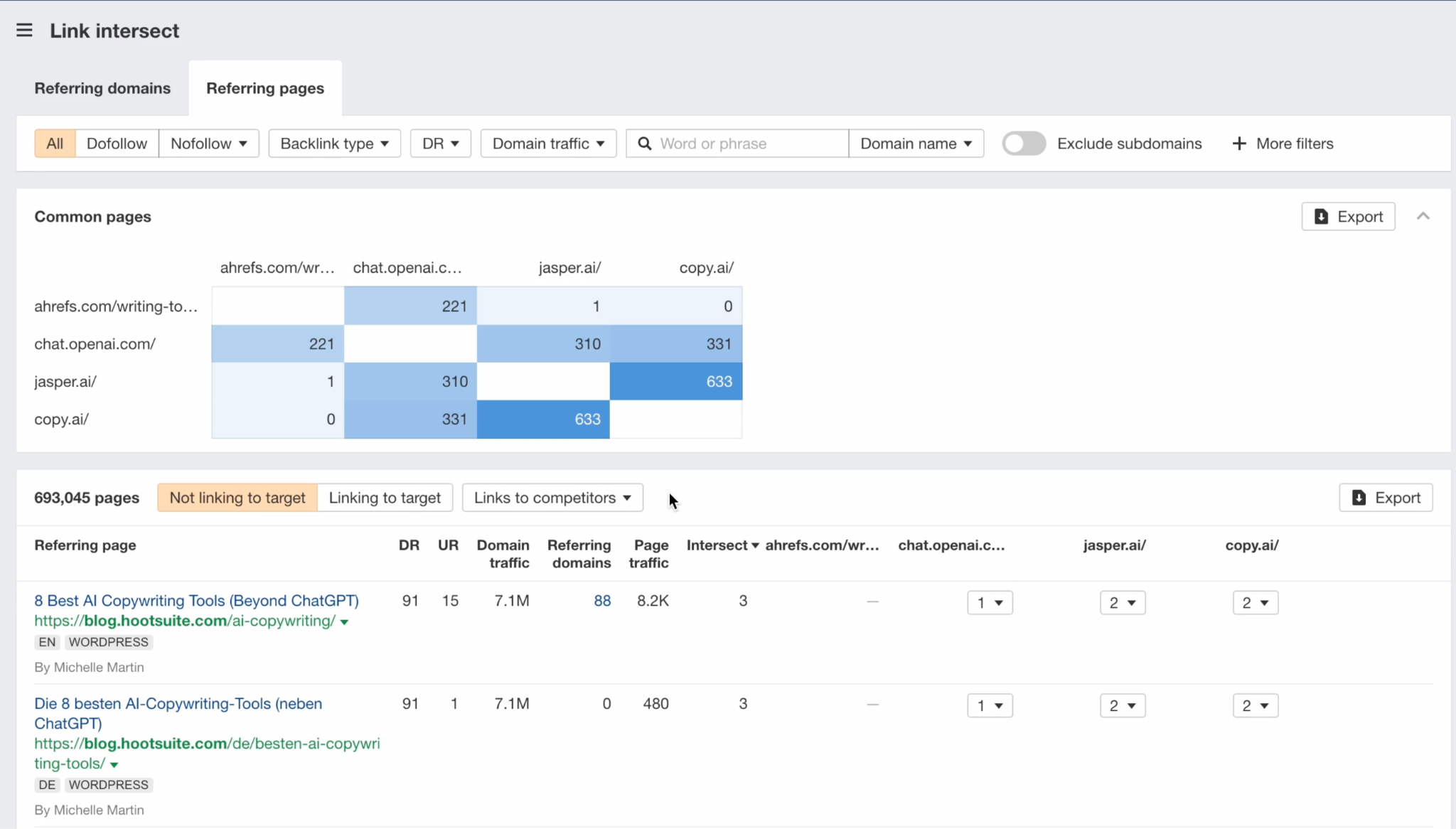
As you can see in the screenshot, the competitor overlap columns are the key feature here. When a domain links to all your competitors but not to you, you can see it right away and act on it. That domain clearly covers your topic and actively links out to resources in your space. Those are your Tier 1 targets.
How to use it: Start with dofollow only. Set DR to a minimum of 50 and domain traffic to a minimum of 1,000. This immediately removes most low-quality noise. If your list is still unmanageable, raise the DR floor to 60 or 70. If it's too short, lower it.
What you get: Domain-level prospecting. You get the referring domain, its DR, its traffic, and how many of your competitors it links to. From here, you need to find the specific page on that domain that's relevant - Ahrefs' "referring pages" mode handles that as a second pass.
Semrush Backlink Gap Tool
Semrush takes a slightly different approach. It classifies domains into categories: Weak (you have a link, but it's lower-quality than competitors'), Strong (competitors have links you don't), Shared (everyone has it), and Unique (only you or only them).
You can see all matches, authorities, and referring domains, and filter based on what you want to prioritize.
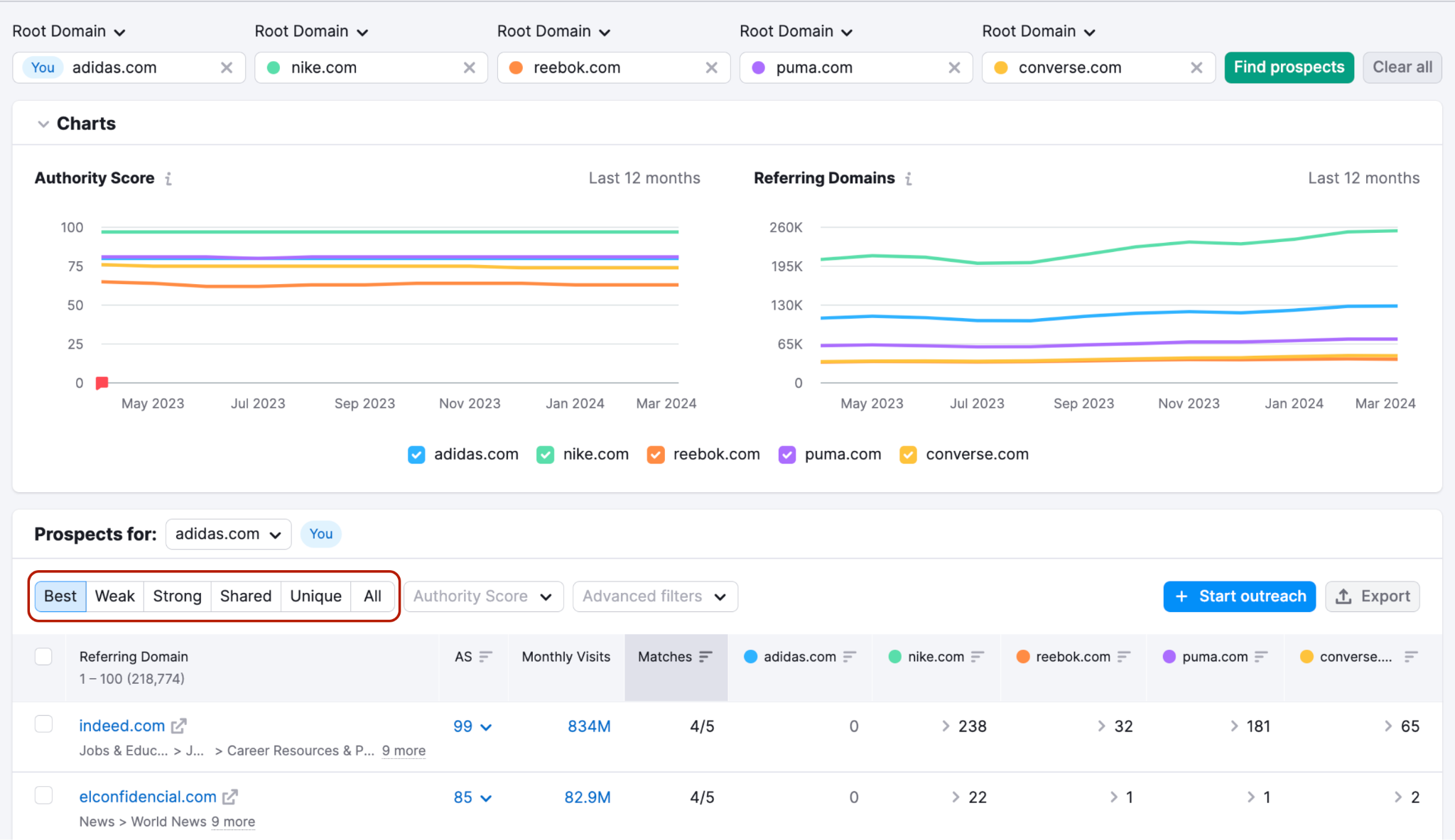
The "Strong" bucket is your direct action list. These are domains where competitors have a clear link advantage.
The "Weak" bucket is underused - if you have a link from a domain but your competitor has a stronger one from the same domain, that's a signal you might be able to upgrade your placement or get a more prominent link.
How to use it: Run it with your top three to five organic competitors (not brand competitors, sites ranking for the same keywords you are). Sort by authority score descending in the "Strong" bucket. That's your starting point.
What you get: Competitive positioning decisions. Semrush is particularly good at showing you where competitors are consistently outgunning you across multiple domains, which helps prioritize categories of link opportunity rather than individual sites.
Manual Gap Analysis (No Paid Tool Required)
If you're a small site or doing a one-off analysis, you don't need a subscription to do this. The workflow is slower, but the logic is the same.
- Pull your top three competitors from Google search for your target keyword.
- Use Monitolink’s free trial, Ahrefs' free backlink checker, or Semrush's free version to pull the top referring domains for each competitor.
- Cross-reference against your own backlink profile manually (Monitolink’s free trial does this automatically) or with a simple spreadsheet VLOOKUP.
- Flag domains that appear for two or more competitors but not for you.
You won't get the scale or precision of a paid tool, but for a single keyword or a small site audit, this is completely viable.
How to Interpret a Backlink Gap
You pulled the gap and found all competitor backlinks. Any tool will do it in five minutes, so the hardest part is yet to come. Backlink gap analysis is more about the analytical work - understanding what it means for your strategy.
Gap Size vs. Gap Quality
A gap of 500 missing domains sounds alarming. But if 400 of them are general directories, low-traffic blogs, and foreign-language sites with no topical relevance to you, the real gap is much smaller.
What matters is the number of high-authority, topically relevant domains where your competitors have links, and you don't.
Topical Relevance Matters More Than DR Alone
A DR 90 link from a massive general news site that links to your competitor's homepage in a "recommended tools" roundup is almost certainly more valuable in absolute terms. But a DR 55 link from an industry-specific publication that covers your exact topic and links contextually within relevant content may bring more ranking movement for a specific keyword cluster.
When you're reviewing gap domains, don't just look at the DR. Open the site. Check what topics they cover. Check which page of your competitor they're linking to and what anchor text they're using. That tells you far more about whether the link is winnable and whether it's worth winning.
The "All Competitors" Signal
When a domain links to every competitor you've entered and not to you, treat that as a high-confidence signal. That domain is actively referencing resources in your space and has repeatedly decided that your site isn't one of them. That's your clearest sign that you're missing something, either in content quality, in visibility, or in outreach history.
These Tier 1 domains should be the first thing you work through, regardless of their individual DR scores.
When A Backlink Gap Isn't Worth Pursuing
Some links your competitors have are structurally unwinnable:
- Editorial links from major publications where your competitor was covered as a news story. You can't replicate a news event.
- Partner or customer links - a SaaS company linking to its own integration partner.
- Paid placements dressed up as editorial content. If every link on a domain follows the same pattern (sponsored label buried in the footer, or ten different tool reviews published in the same week), treat it with skepticism.
- Alumni or association links tied to a specific founder's history or professional network.
When you spot these patterns, remove them from your list and move on. Chasing unwinnable links wastes backlink outreach capacity you should be spending on real opportunities.
For a broader look at auditing the links you already have before layering in gap data, our backlink profile audit guide walks through the full process.
How to Prioritize Websites After A Backlink Gap Analysis
Once you've pulled your gap data and removed the noise, you need a prioritization framework - otherwise, a list of 300 domains is just a list. Here's the structure I’ve used and seen work for many agencies:
Baseline filters before you prioritize:
- Dofollow only (unless you have a specific reason to want nofollow)
- DR 50+ for most sites; lower to 40 if you're an earlier-stage site
- Domain traffic 1,000+ monthly visitors
- Topically relevant to your niche
Remove these outright: blog rolls, general directories, press release syndication networks, irrelevant industry verticals, foreign-language domains unless you publish in that language.
What you're left with is an actionable prospect list you can hand to whoever runs outreach, or work through yourself with a simple backlink outreach tool.
How to Do the Outreach After the Gap Analysis
Gap links are warm targets. The domain already links to content in your space, so you're not cold-pitching. You're showing up to a conversation that's already happening and making the case that you belong in it.
That's a fundamentally different pitch than standard link outreach - and it should read differently.
Check for Unlinked Brand Mentions
Before you start cold outreach to gap domains, check whether any of them mention your brand or product without linking to it. These are the easiest conversions: the editor already knows you exist, already found you worth mentioning, and just didn't link to you. A short, friendly email asking them to add the link converts at a much higher rate than any cold pitch.
You can find these in Google Search Console if the volume is high enough to appear in the referral data.
The Two Pitches that Work for Gap Links
If you don’t have unlinked mentions from their domain, you can use two angles to try to get a backlink:
Resource replacement: "You link to [competitor] for [topic]. We've published something more comprehensive / more recently updated/covering an angle they miss. Here's the link." This works when your content is genuinely better or more up to date. Don't use it when it isn't - editors see through it immediately.
Coverage gap: "You cover [topic] regularly. Your readers would also benefit from a piece on [adjacent topic they haven't covered]. Here's what we've written." This works when you can point to a real gap in their content coverage that your piece fills.
What to Include in The Backlink Gap Outreach Pitch
- The specific URL on your site you want linked (not your homepage)
- The specific page on their site where the link fits contextually
- One concrete reason why your content adds value for their readers
- Keep it under 150 words. Editors don't read long pitches.
We have a guide with tested link building outreach templates you should check out before the outreach itself.
How to Track Progress and Protect What You've Built
Your job isn’t done with outreach (sadly). When you close a gap, you can still lose a link that will reopen that gap. So, you need the follow processes running in the background:
Monitolink handles competitor monitoring, lost link detection, and link reclamation automatically - new gaps and lost links surface in your dashboard without manual re-runs. If you need to recover a lost link, we've also written a full guide on the link recovery process.
Final Thoughts on Backlink Gap Analysis
The backlink gap isn't a data problem, because it can be retrieved with tools in seconds. It's more of a strategy problem, and you need hard work to understand which gaps explain the difference in rankings and how to act on them.
Always prioritize by competitor overlap and close Tier 1 first. And to do that sustainably, monitor continuously so new gaps surface before they compound. You can test Monitolink for 14 days (no credit card required, for free) to see how this can be done automatically from a single place.
Frequently Asked Questions
What's the difference between a backlink gap and a content gap?
A content gap is about topics and keywords your competitors rank for that you don't. A backlink gap is about authority signals and domains that vouch for your competitors but not for you.
Can you do a backlink gap analysis for free?
Yes, with limitations. Monitolink, Ahrefs, and Semrush both offer free versions with restricted data. You can manually cross-reference competitor backlinks using their free checkers and a spreadsheet. The free approach works for small sites or one-off analyses.
How many competitors should I include in a gap analysis?
Three to five is the practical range. More than five adds noise and makes the "all competitors have it" tier less meaningful. Focus on organic search competitors (sites ranking for the same keywords), and not brand or business competitors.
What DR threshold should I use when filtering domains for a backlink gap analysis?
DR 50+ is a reasonable baseline for most sites. If you're an early-stage site with a DR below 30, you might lower it to 40. If you're an established site in a competitive vertical, raise it to 60 or 70 to focus your effort on the links that will actually move rankings.