
Backlinks fall into three overlapping categories: how they're built (dofollow, nofollow, sponsored, UGC), how they're earned (editorial, guest post, digital PR, directory, etc.), and where they show up on the page (in-text, footer, sidebar, widget).
The rest of this guide breaks down every backlink type you'll come across, which ones are actually worth chasing, and something most guides leave out - how these same links now affect whether AI tools cite you.
What Makes a Backlink Good in 2026
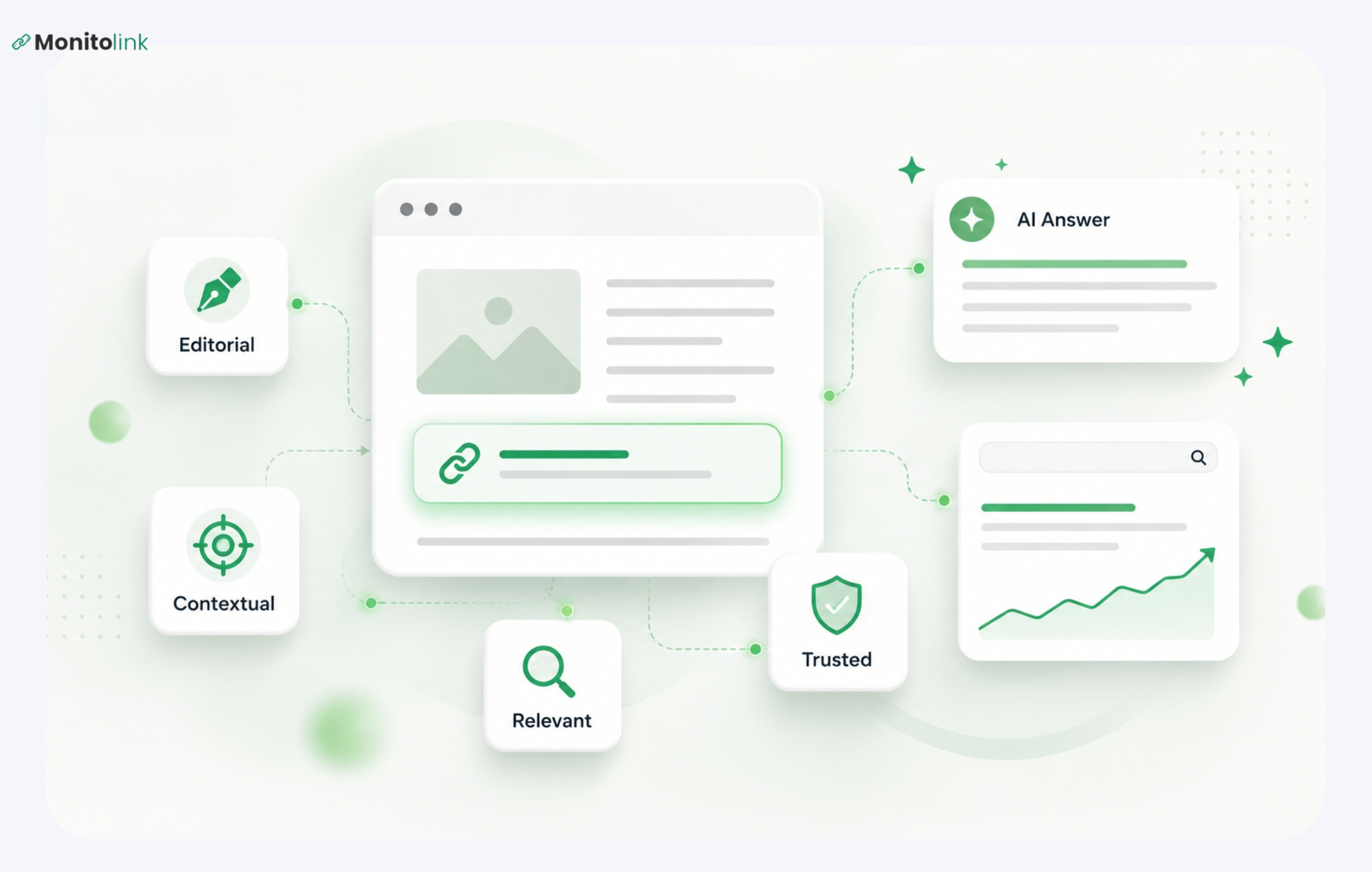
Before you sort backlink types into "worth it" and "skip it," you need the criteria you're sorting by. Five things determine whether a backlink helps:
- Relevance - Does the linking page sit in your topic or industry, or is it random?
- Source authority - Is the linking site itself trusted?
- Anchor text - Does the clickable text describe what you're linking to?
- Placement - Is the link in the main content, or in a footer, sidebar, or widget?
- Machine-readability - Would an LLM's retrieval pass or training data surface this mention when someone asks a related question?
A nofollow link on a well-trafficked, topically relevant page can do more for your brand's AI visibility than a dofollow link on a forgotten directory - because AI answer engines don't parse rel attributes the way Googlebot does. They read content, context, and how often you're mentioned alongside a topic. We'll come back to this later, but keep it in mind as you read the rest of this list: SEO value and AI-citation value aren't always the same thing anymore.
4 Types of Backlinks by HTML Attribute
Every link on the web falls into one of four categories based on its rel attribute that determines whether a link passes ranking authority at all.
1. Dofollow is the default type. If a site doesn't add anything special to the link, it passes authority to you. This is what you want most of - but if every single backlink you have is dofollow and from random, unrelated sites, it actually looks suspicious to Google instead of helpful.
2. Nofollow tells search engines not to pass ranking value through that link. Google introduced it back in 2005 to cut down on comment spam. Now it's the norm on social media, most guest post author bios, and sponsored content. It won't boost your rankings much, but it still drives referral traffic - and increasingly, it seems to matter for getting cited by AI tools.
3. Sponsored is the tag Google requires on any paid placement, affiliate link, or ad. If you leave this off a paid link, it's a violation of Google's guidelines and can get flagged in a manual review.
4. UGC (user-generated content) marks links that came from your users - comments, forum posts, reviews. These don't do much for your rankings, but they keep you from getting penalized for spam you didn't create.
A proper backlink profile audit will show you the ratio of which ones dominate your site.
18 Types of Backlinks by How They're Acquired
This is where most of the real strategy work happens. Group these into four tiers based on how much value they carry and how much risk they come with.
Tier 1: Earned Links
1. Editorial Backlinks
These happen when another site links to your content because it's genuinely useful - no outreach, no payment. A journalist citing your original research, a blogger referencing your data. Google explicitly favors these over every other type, and they're also the links most likely to get you cited by AI tools, since editorial mentions tend to sit on high-authority, frequently-crawled pages.
2. Digital PR Backlinks
Links earned when your brand, product, or research gets covered by media outlets. These usually come from press coverage of a study, launch, or newsworthy angle. Even when the link itself is nofollow (common with press coverage), the exposure often triggers additional organic links from people who saw the story.
3. HARO and Journalist-Platform Backlinks
Platforms like Connectively (formerly HARO), Featured, and Qwoted connect journalists with expert sources. You answer a query, they use your quote, you get a link back - usually from a high-authority publication. This is slow, but it compounds: once you're quoted a few times, journalists start reaching out to you directly.
4. Resource Page Backlinks
Getting your guide, tool, or site added to a curated "helpful resources" page. These convert well because the page owner has already done the vetting - they're actively recommending you.
5. Broken Link Replacement
Find a dead link on a relevant, high-authority site and offer your content as the replacement. It's a genuine favor to the site owner (they get a working link, you get a placement), which makes the outreach conversation easier than a cold ask.
If you want the mechanics, we walked through the exact process for finding and fixing broken backlinks.
6. Testimonial Backlinks
Give a genuine testimonial to a tool or service you use, and many companies will publish it with a link back to you. Ethical and surprisingly underused.
Tier 2: Proactive/Outreach Links
7. Guest Post Backlinks
Write an article for another site in your niche, with a link back in your bio or naturally within the content. Google doesn't penalize guest posting itself - it penalizes guest posting at scale for the sole purpose of link placement. The difference is whether the content adds real value or exists purely to house a link.
8. Niche Edits (Link Insertions)
Also called contextual link insertions - you request that your link be added into an already-published, already-ranking piece of content on someone else's site. These work fast because the page is already indexed and trusted; you're not waiting for new content to build authority.

9. Business Profile and Directory Backlinks
Google Business Profile, industry-specific directories, and chamber of commerce listings. Individually low-impact, but they compound for local SEO and reinforce NAP (name, address, phone) consistency - which matters for both search rankings and how confidently AI tools can identify your business as a real, verifiable entity.
10. Podcast and Webinar Backlinks
Being a guest gets you a link in show notes or a speaker bio - usually from a site with an engaged, relevant audience. These are slower to scale but tend to bring qualified referral traffic.
If your process for pursuing any of these tiers is still "email people and hope," it's worth tightening up the outreach itself - we broke down templates and sequencing in link building outreach templates and strategies guide.
Tier 3: Passive & Low-Equity Links
11. Press Release Backlinks
Fine for genuine news - a launch, funding round, partnership - but nearly always nofollow, and Google has said its algorithm largely ignores links inside press releases regardless of the tag. Use these for visibility and brand mentions, not link equity.
12. Social Media, Comment, and Forum Backlinks
Almost always nofollow. These types of backlinks won't affect your rankings, but they will add to a natural, diverse backlink profile and can bring real referral traffic if you're participating in the conversation, not just dropping a link and leaving.
13. Reciprocal Links (Link Exchanges)
A bit of reciprocal linking between sites that genuinely make sense together is normal - that happens naturally. The problem is when it becomes a pattern: "you link to me, I'll link to you," done at scale. Google's guidelines specifically call that out as a link scheme.
14. Widget Backlinks
Embeddable tools or calculators that carry a link back to you. Google has specifically warned about hidden or keyword-stuffed widget links since 2016. If you use widgets, keep the link visible and consider nofollow.
Tier 4: Manipulative & Penalized Links
15. Private Blog Networks (PBNs)
A network of sites built solely to link to your "money" site. Google has gotten significantly better at detecting PBN footprints, and the downside - deindexing - is not proportional to the upside.
16. Paid Dofollow Links
Buying links outright violates Google's spam policies. This includes non-cash trades too: free products in exchange for a review and a dofollow link count as payment in Google's eyes.
17. Automated/Spun-Content Links
Tools that mass-generate low-quality articles stuffed with links. These get filtered or penalized, and they pollute your own backlink profile in the process.
18. Spammy Forum and Comment Link Drops
Posting a link with no real contribution to the discussion. This is different from genuine forum participation - the line is whether the link adds value to the reader or only to you.
4 Types of Backlinks by Placement
Where a link sits on the page changes how much weight it carries, independent of how it was acquired.
- In-text/contextual links - inside the body content, surrounded by relevant text. The most valuable placement, because the surrounding context helps both search engines and AI systems understand what the link is about.
- Image and alt-text links - clickable images or credit lines under photos. Useful for niche traffic and attribution, but search engines can't read image content directly, so descriptive alt text matters more here than almost anywhere else.
- Footer links - low visibility, low click-through, and generally treated as less natural by Google, especially if they're sitewide.
- Sidebar and widget links - similar to footer links: present on every page, rarely clicked, minimal weight.
If you're evaluating a backlink opportunity and it's not clear which placement you'll get, ask before you commit outreach time to it.
Backlink Types and AI Visibility: What's Different in 2026
Unlinked brand mentions now carry weight they didn't used to. When your brand is cited by name on an authoritative page - with or without a hyperlink - it can influence whether an LLM surfaces you in a generated answer. AI systems are pattern-matching on entity mentions and context, not crawling for rel attributes.
Editorial and digital PR links are doing double duty. The same coverage that earns you a dofollow link from a respected outlet is also the coverage most likely to get pulled into an AI-generated summary on your topic. If you're prioritizing link types by SEO value alone, you're underinvesting in exactly the type that also builds AI visibility.
Rel attributes like "nofollow" are basically a Google thing, a signal meant for its crawler. AI engines don't necessarily follow the same playbook. So a nofollow link on a page that gets solid traffic and fits your topic can still earn you AI citations, even if it does zero for your PageRank. Don't write off a placement just because it's nofollow, it might still be worth having.
Consistency across your entity footprint matters more than ever. Business profiles, directories, and social bios all reinforce the same signals - brand name, description, and NAP data - that help both search engines and AI systems disambiguate your brand from anything similarly named.
None of this changes the fundamentals. It just means your link building priorities should now be evaluated against two questions instead of one: does this help me rank, and does this help me get mentioned when someone asks an AI tool a question in my space?
Which Types of Backlinks to Prioritize First
If you're building a link building plan from scratch, here's the order of operations, roughly by effort-to-impact ratio:
If you're managing this across a handful of client sites, chasing every opportunity manually stops scaling fast. A backlink gap analysis against your competitors is usually the fastest way to find out which of these types you're missing.
Auditing and Maintaining a Healthy Backlink Profile
Building links is only half the job. Links break, pages get deleted, and sites you earned coverage from occasionally go under or restructure. A backlink you earned two years ago doing nothing for you today is a common, quiet problem.
A few habits worth building into a regular cadence:
- Check your backlink profile monthly - more often if you're actively running outreach campaigns, less often for stable, low-competition sites.
- Watch for lost links, not just new ones. A link that disappears from a high-authority page is worth chasing down and requesting reinstatement. This is basically free link equity if you catch it - our guide to recovering lost backlinks walks through the process we use.
- Disavow genuinely toxic links, but don't get trigger-happy - most nofollow, low-authority, or irrelevant links just don't matter enough to bother with.
- Track what's driving traffic and rankings. Ten resource-page links from relevant, high-authority sites beat two hundred low-quality directory submissions every time.
This is the exact workflow we built Monitolink’s backlink monitoring tool around - tracking not just whether a link exists, but whether it's still live, still relevant, and still worth having. If you're currently doing this in spreadsheets, a 14-day free trial will show you in about ten minutes whether it's worth switching.
Frequently Asked Questions
Do backlinks affect visibility in ChatGPT or Google's AI Overviews?
Indirectly, yes. AI systems don't parse rel attributes, but they do pick up on brand mentions, context, and how consistently you're cited across authoritative sources - which means editorial coverage and digital PR now serve double duty as both SEO and AI-visibility plays.
What's the safest type of backlink for a new website?
Business profile and directory listings, combined with genuine guest posts on relevant, moderate-authority sites. Low risk, and they establish the consistency signals that make later, higher-value links more effective.
How many types of backlinks should a healthy profile include?
A mix, not a monopoly. A profile made up entirely of one type - even a "good" type like dofollow guest posts - looks unnatural. Aim for a blend across editorial, guest post, directory, and social mentions, weighted toward the higher-value tiers.
How do I know if my current backlink profile is helping or hurting me?
Run a backlink profile audit to see your dofollow/nofollow ratio, source relevance, and anchor text distribution - then compare it against a competitor backlinks analysis to see what you're missing that they're not.